
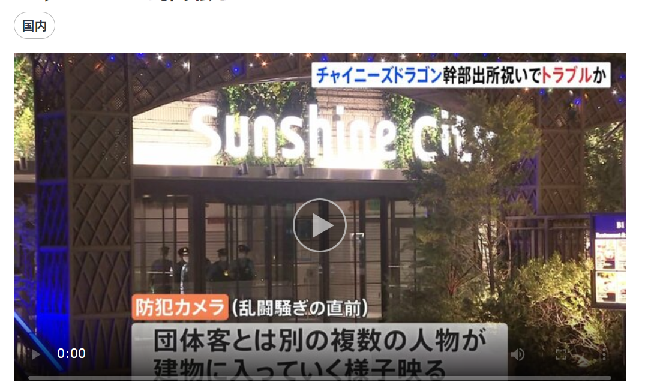
TBS News, October 17, 2022, “Trouble at Chinese Dragon Executive’s Release Celebration? Brawl at Ikebukuro Sunshine 60” (https://newsdig.tbs.co.jp/articles/-/180276?display=1)
A group brawl in downtown Ikebukuro recently caused a stir. About 100 people gathered at a French restaurant in Ikebukuro for a party, and about 10 of them started beating each other up, which turned into a big fight. The party was attended by the infamous “Chinese Dragon,” and the incident became the focus of public attention.
The “Chinese Dragon” was derived from a group of delinquents consisting mainly of children of Japanese orphans who came to Japan when their parents emigrated to China, and was composed of Chinese Koreans and Japanese.
The “Chinese Dragons” are fearless, and have a bloodthirsty temperament that will turn on even Japanese yakuza leaders if they feel dissatisfied or frustrated.
From the 1970s to the 1980s, there was a strong impression that when it came to fighting, it was Kokushikan High School versus Chosun High School.
Around the 1990s, Kokushikan High School and Chosun High School began to focus more on club activities, and group brawls between the two schools in downtown areas around the Tokyo metropolitan area became less conspicuous.
In the 1980s, the “issue of repatriation of Chinese residual orphans” began to appear frequently in the popular news.
After World War II, there were many Chinese orphans left behind in Manchuria (present-day Jilin, Heilongjiang, and Liaoning provinces in northeastern China) because their Japanese parents returned to Japan after the war, leaving their children behind in China.
The orphans were raised by Chinese or by Koreans living in Manchuria at that time. Some of them emigrated to Korea later, but most of them remained in Manchuria at that time.
Some of you may recall that in 1981, a “survey team of orphans visiting Japan” came to Japan, and since then, “the Japanese names of the orphans and their characteristics at the time of their disappearance were read out extensively on TV. Those who found relatives in Japan were able to return to Japan, but an unexpected problem emerged.
Suddenly, the governments of Japan and China decided that Japanese who had been certified as residual orphans should live in Japan, saying that they had a birth parent whose face they did not know, that they must return to Japan, and that they were to return to Japan on what date.
The orphans returned to Japan, unable to grasp the reality of their situation, and were suddenly forced to give a press conference in front of the media. Some of them had grown up as Koreans and could not even speak Chinese. At the press conference, some of them said in Korean with a Korean accent, “I don’t know how to express my feelings. I, who could understand Korean, remember that scene vividly.
Some of the orphans who were suddenly forced to move to unfamiliar Japan could not speak Japanese and could not find work immediately in Japan, and their standard of living was lower than that of the Chinese. The outlet for the frustration of the remaining orphans became violence against their children, and the children also became frustrated by being “bullied” by the Japanese at school. In order to “break down the bullying,” the predecessor group of the “Chinese Drangon” (tentatively called the “Residual Orphans Group”) rose to power through violent methods. We interviewed one of the members of the group at that time, who said, “Violence gave us a sense of pleasure every time we repeated it, and it was also a great stress reliever, as we were able to exterminate the Japanese. Therefore, they became more violent with each expedition.
Many of the remaining orphans who returned to Japan were raised by Chinese Koreans. This is not surprising since there were many Koreans living in Manchukuo.
Even for the children of the remaining orphans who were raised by Koreans, transferring them to Korean schools that existed in various parts of Japan was not considered an option by the Japanese government or its supporters.
Today, some Chinese Korean students are enrolled in Korean schools, but at that time there were no cases of Koreans enrolling in such schools.
In the 1990s, when the children of Chinese orphans were students, a group brawl between a “residual orphan group” and Korean high school students occurred in Tokyo. Although Korean high school students had calmed down a little in the 1990s, they were still Korean high school students at heart, and there were not a few who would brawl if they lost their temper.
The other side was also a group of children of orphaned children raised by Koreans who had lived with emotional scars, and even though they were derived from the same Korean ethnic group, when Koreans lose their temper and get into a fight, both sides do not back down even if they are from the same ethnic group.
As a result, both sides got into a big fight that resulted in many injuries and even hospitalized patients.
A few days later, they learned that a group of orphans was watching the ward where the injured Korean high school student was hospitalized, vigilantly watching for an opportunity to launch a retaliatory attack. At that time, I caught a glimpse of the amazing persistence of the residual orphans group.
At the time, fearing further incidents, a male teacher at a Tokyo Korean high school was assigned to the night shift to provide security at the hospital where the student was hospitalized.
A classmate of the student later told us, “The student did not want others to see the scar on his arm where he was cut by a group of residual orphans with a knife. He must have suffered a deep scar that will not disappear for the rest of his life.
It is possible that the “Chinese dragons” that emerged from the group of orphaned children have become even more violent than they were in the 1990s due to the cycle of violence and the improvement of their standard of living. Once violence breaks out at a party where such “Chinese Dragons” gather, it is likely to develop into a huge riot like the recent incident in Ikebukuro and be unstoppable.
They are at the mercy of the policies of the Japanese and Chinese governments, and I feel sorry for them. If the same scale of immigration problems arise in the world in the future, the existence of the “Chinese Dragon” can be said to be a great human experience in terms of considering the “future life of immigrants.
Manchukuo was originally supposed to advocate “harmony among the five races” as its motto, but why has history taken such a mysterious and incomprehensible turn…? What was the “harmony of the five races” advocated by Manchukuo for?
If we continue to repeat the tragedy of the melee, the last emperor, “Aixinjueluo Puyi
I wonder if the last emperor “Aixinjueluo Puyi” will ever be reborn as a Buddha….
It is a well-known fact that the Japanese orphans who remained in China suffered indescribably in those days.
However, is it good for them to rebel in the face of adversity, or is it not a severe test given to them to crawl back up?
Did not Private Norakuro, the protagonist of the manga “Norakuro,” overcome his ordeal and crawled up in the end?
Of course, Private Norakuro was a private in the Imperial Japanese Army.
The historical background of the manga “Norakuro” is Manchukuo.
When will the day come when the “harmony of the five races” is realized?