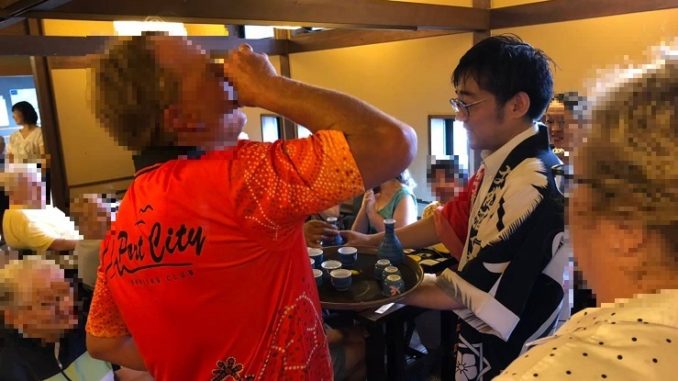
Mr. Arisawa serves “Kikunohana”.
COVID-19 is spreading around the world and affecting many places, and Japan has been greatly affected.
For example. Lifestyle changes such as remote working and the spread of take-out menus in restaurants are common in all countries. However, COVID-19 has even undermined the unique Japanese culture. One such example is the drinking and eating culture of Kochi Prefecture.
In Kochi Prefecture, there is a culture called “kenpai/henpai(offering and returning the cup).
In the kenpai ceremony, the person below moves to the seat of his or her superior with his or her own cup and sake bottle, pours sake into his or her own cup, drinks it down, and then presents his or her cup to the superior to pour the sake into it.
The “henpai” is a Kochi-style communication method in which the two parties drink from the same cup to deepen their exchange. The recipient of the “kenpai” drinks up the sake, returns the cup to the recipient, and pours sake into the cup.
The recipient of the “henpai” is required to drink all the sake poured into the cup.
This culture of “offering and returning the cup” was an effective way to communicate with superiors and guests, and was an effective culture for structuring human relationships.
However, Kochi Prefecture felt that this could contribute to the spread of COVID-19.
Therefore, it prepared a notice, “Request for Voluntary Refrain from kenpai/henpai” and propagated it to the people of Kochi Prefecture.
In response, the business community in Kochi Prefecture refrained from “donating and returning” cups, and this trend continues to this day.
In addition to this, there is a “game” of drinking sake in Kochi. These are the “Kiku-no-hana(chrysanthemum flower)” and “Bekuhai” games. In “Kiku no Hana,” several ochoko (saké cups) are placed upside down on a tray, a chrysanthemum is placed in one of the cups, and the participant turns the cup upside down.
The ochoko are turned over until a chrysanthemum flower appears, and the person who draws the chrysanthemum flower drinks the number of sake cups that have been turned over.
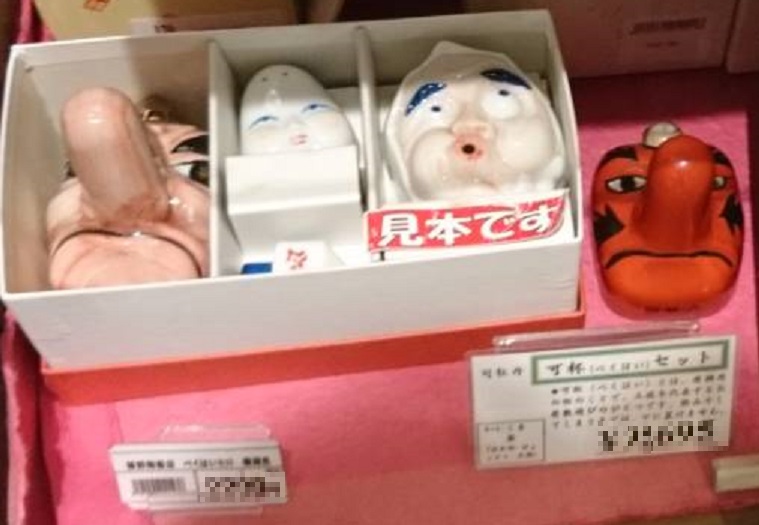
On the other hand, “bekuhai” was originally a game to enjoy sake in a tatami room.
A “Tosa geiko(geisya)” sings a song such as, “Bero bero no kami wa honto no kami yo,” while several people around the table spin the top of a top.
The person pointed to by the top of the frame is given a sake cup with the design of a “Tengu,” “Hyottoko,” or “Okame,” and the cup cannot be put down until the person has drunk all of the sake in the cup.
We interviewed Mr. Ryoji Arisawa of Arisawa Sake Brewery, which also operates a restaurant in Kochi Prefecture, to learn more.
Since both “kikunohana” and “bekuhai” are games in which people drink from the same cup as others, Kochi
Prefecture, wishing to avoid the spread of COVID-19, has been asked to refrain from these games.
This is an example of how COVID-19 has made it impossible to maintain traditional culture.
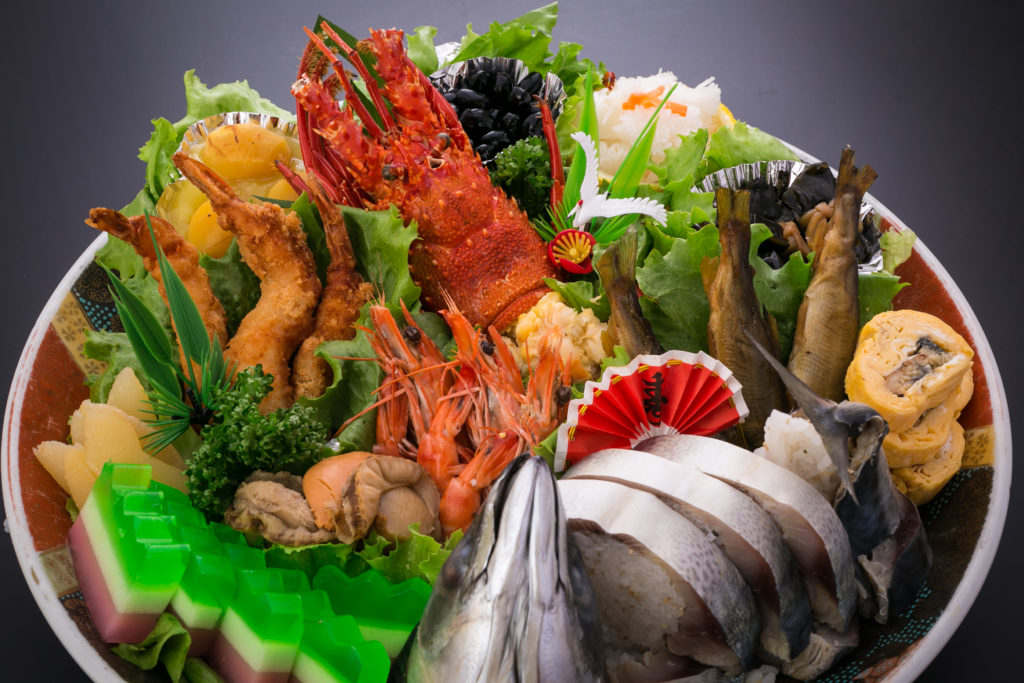
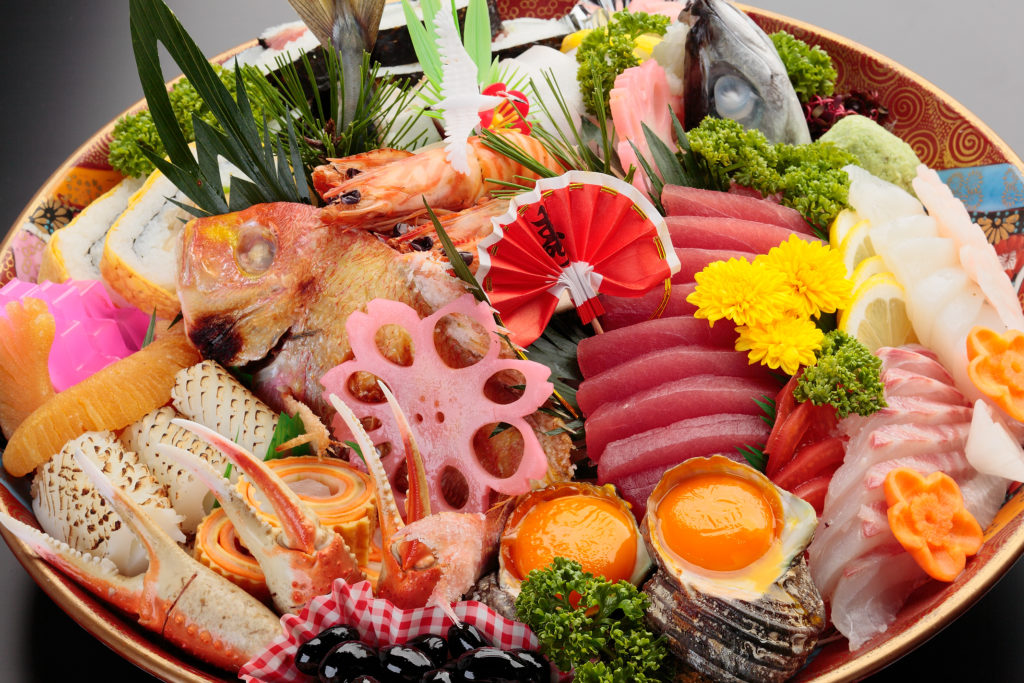
On the other hand, in Kochi Prefecture, there is a large dish called “Sawachi-ryori”. In this dish, an appetizer, sashimi, main dish, and dessert are all served on a single plate, and all attendees share the food from the plate.
Originally, the dish was served with a single pair of chopsticks, but this, too, could encourage the spread of COVID-19, so Kochi Prefecture instructed that tongs be provided for each attendee and that each person should share the dish.
Currently, restaurants that serve “Sawachi-ryori” dishes either continue to serve the dish on a platter and give tongs to each attendee as before, or serve the dish in individual portions from the beginning. (The above is Mr. Arisawa’s statement.)
Speaking of the spread of COVID-19 and changes in food culture, the way people eat “kushikatsu” in Osaka, Japan has also changed.
Originally, kushikatsu was eaten by dipping the cutlet into the sauce in a large sauce box placed at the table, but the sauce box has now been removed. The reason is that sharing the same sauce causes corona to spread.
Therefore, a bottle of sauce is placed at each seat, which is then poured over the kushikatsu on each person’s plate.
Kushikatsu, like “sahachi cuisine,” is an example of a change in the way people eat and serve kushikatsu as a result of the spread of COVID-19.
However, since “sahachi ryori” and “kushikatsu” are not examples of culture or voluntary restraint in serving, they can be said to be examples of new developments in the way people eat.
On the other hand, there is another culture that has been forced to refrain from the spread of COVID-19, as was the case with “kenpai /hempai” in Kochi.
On the other hand, there is another culture that has been forced to refrain from the spread of COVID-19, as was the case with “kenpai /hempai” in Kochi.
In Japan, there is a culture of enjoying tea called Sado (tea ceremony). Among the manners of tea ceremony, there is one called “koicha,” in which tea is served in the same tea bowl and passed around among the participants.
However, because this also uses the same tea bowl and leads to the spread of COVID-19, tea ceremony organizers are now refraining from “koicha” tea ceremonies.
There are many examples of how the spread of COVID-19 is damaging Japanese culture, and the above is just one of them.
Although some are refraining from traditional culture because of the spread of COVID-19, we also believe that it will trigger the creation of new ways of eating and manners, such as “Sawachi-ryori” and “kushikatsu”.
We hope that those who carry on traditional Japanese culture will not be defeated by COVID-19 and will work to maintain and develop the culture.
The first one
Bek Hai’s cups
Left Tengu
Center: Okame
right, a hyottoko
Second one
Sawachi-ryori1
Third one
Sawachi-ryori2